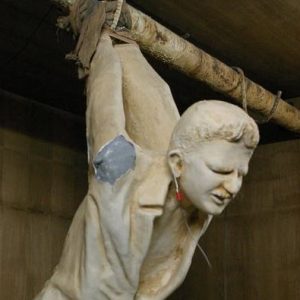
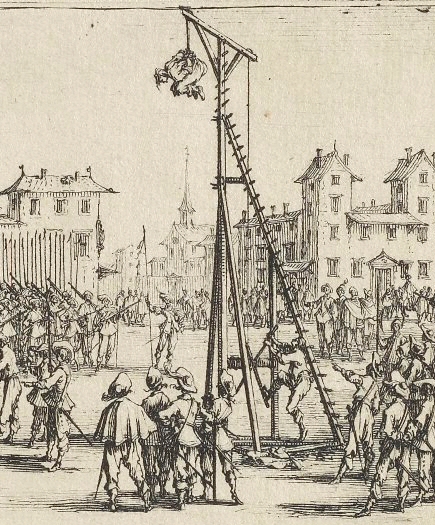
The strappado (also called the corda) was a form of torture in which a person was bound by the wrists behind the back, hoisted into the air by a rope, and sometimes dropped suddenly or held suspended. The victim’s own body weight pulled violently on the shoulders and arms, often causing shoulder dislocation, torn ligaments, severe nerve damage, and even long-term paralysis.
Unlike some legendary medieval torture devices, strappado was simple, brutally effective, and widely used.
The Strappado in Medieval Times
The strappado was used from at least the late medieval period into the early modern era. It became especially common because it required no complex machinery, it left fewer visible marks than cutting or burning, and it could be applied in a “controlled” way.
Authorities often claimed torture was used only to extract confessions or information, though in reality it was frequently abused.
How the Strappado Worked:
- The victim’s hands tied behind their back;
- A rope was attached to the wrists; and
- The victim was lifted off the ground.
The shoulders are forced backward unnaturally, producing extreme pain quickly.
Strappado was favored because it was cheap and easy to set up, extremely painful without immediate death, capable of producing confessions quickly, and harder to prove afterward compared to mutilation. It fit the legal culture of the time, where torture was often considered part of formal investigation.
Was the Corda Torture Real?
Strappado is one of the best-attested torture methods in European history because it appears in court documents, inquisition trial records, legal manuals, and multiple eyewitness reports.
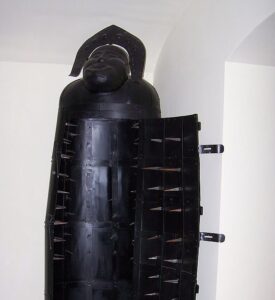
It was not a later myth like the “iron maiden.” It was a real method used by authorities across multiple countries.
More severe versions:
- Sudden drops: The victim was raised and dropped abruptly, jerking the arms.
- Weights added: Heavy stones or metal were tied to the feet.
- Repeated sessions: Torture could be stopped and restarted.
- These variations made strappado even more damaging.
Where Was Strappado Used?
Spanish Inquisition: The Spanish Inquisition used a form of strappado known as la garrucha. It is one of the clearest documented torture methods in their records.
Italian City-States: Renaissance Italian courts used strappado frequently, especially against political prisoners.
France and the Holy Roman Empire: Versions of suspension torture were standard tools of interrogation.
Ottoman Empire: A similar method existed, showing that suspension torture was not unique to Europe.
Examples of Strappado in Use: Inquisition Records
Trial documents show strappado being used against accused heretics, Protestants, Jews accused of “secret practice,” and others. In these records, torture was often described bureaucratically, such as: “The prisoner was subjected to the cord…”
This cold phrasing is one reason we know it was routine.
Examples of Strappado in Use: Political Prisoners
Strappado was also used outside religious contexts, especially against suspected spies, rebels, and criminal suspects. It was a tool of state power, not just church courts.