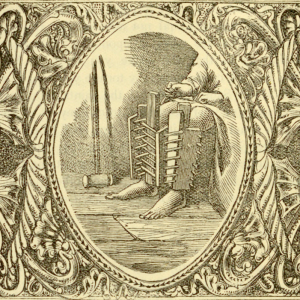
The Spanish boot was a family of torture instruments designed to crush, dislocate, or severely injure a person’s foot and lower leg by enclosing it and applying pressure. The most notorious version involved an iron casing or heavy wooden sheath around the limb, into which wedges or clamps were hammered or tightened to force flesh and bone inward.
Despite the name, it was not a signature tool of the Spanish Inquisition. In fact, torture by the Inquisition typically avoided methods intended for permanent mutilation, focusing instead on pain to elicit information.
The Spanish Boot in Medieval Times
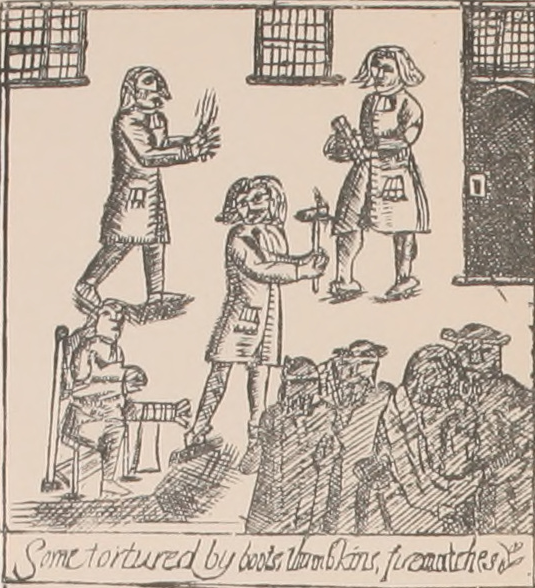
The boot was often was used as an interrogation device to extract confessions or names by threatening permanent disability with incremental pain rather than instantaneous death.
In its basic version, the process was as follows: The victim’s bare foot and lower leg were placed inside a rigid iron or wooden “boot.” Wedges, clamps, or screws were driven between the casing and the victim’s flesh. With each turn of a screw or hammer blow, pressure increased — crushing flesh, breaking bones, and causing excruciating pain.
Variants and Intensifiers
The basic Spanish boot had several regional or historical variations:
- Metal casing with wedges: Wood or iron was hammered in to crush the limb.
- Shin crusher: Two curved iron plates with spikes or knobs were tightened around the calf to break the tibia and fibula.
- Boiling water or oil: In some versions, the boot could be filled with boiling liquids to cook the flesh from the inside out.
- Fire-heated leather boot: Early forms used soaked leather drawn onto the leg and heated, shrinking the material and squeezing the bones.
These variations made the boot not just physically devastating but psychologically terrifying.
Was the Boot Torture Torture Real?
The Spanish boot was a real torture instrument used historically across Europe from at least the late medieval period into the early modern era. Examples survive in museum collections, and many contemporary legal codes even specified its use.
It appears in torture manuals, judicial records, and surviving artifacts, particularly in regions like Scotland, France, and parts of the Holy Roman Empire.
Unlike many mythologized medieval torture devices, the Spanish boot is clearly documented and archaeologically attested. It represents how justice systems of the era often blurred the line between punishment and forced confession and how physical suffering was structured into legal practice long before modern human rights concepts.
Geographic & Historical Context
The Spanish boot was not limited to Spain despite its name. Versions were widely used in judicial torture; Scottish sources even refer to them as “Buskins.” France and the Holy Roman Empire also had variants that show in both regions’ torture records. Lastly, surviving examples from the 16th–18th centuries were documented in the Constitutio Criminalis Theresiana, a legal code cataloguing torture instruments before Austria abolished judicial torture in 1776.